

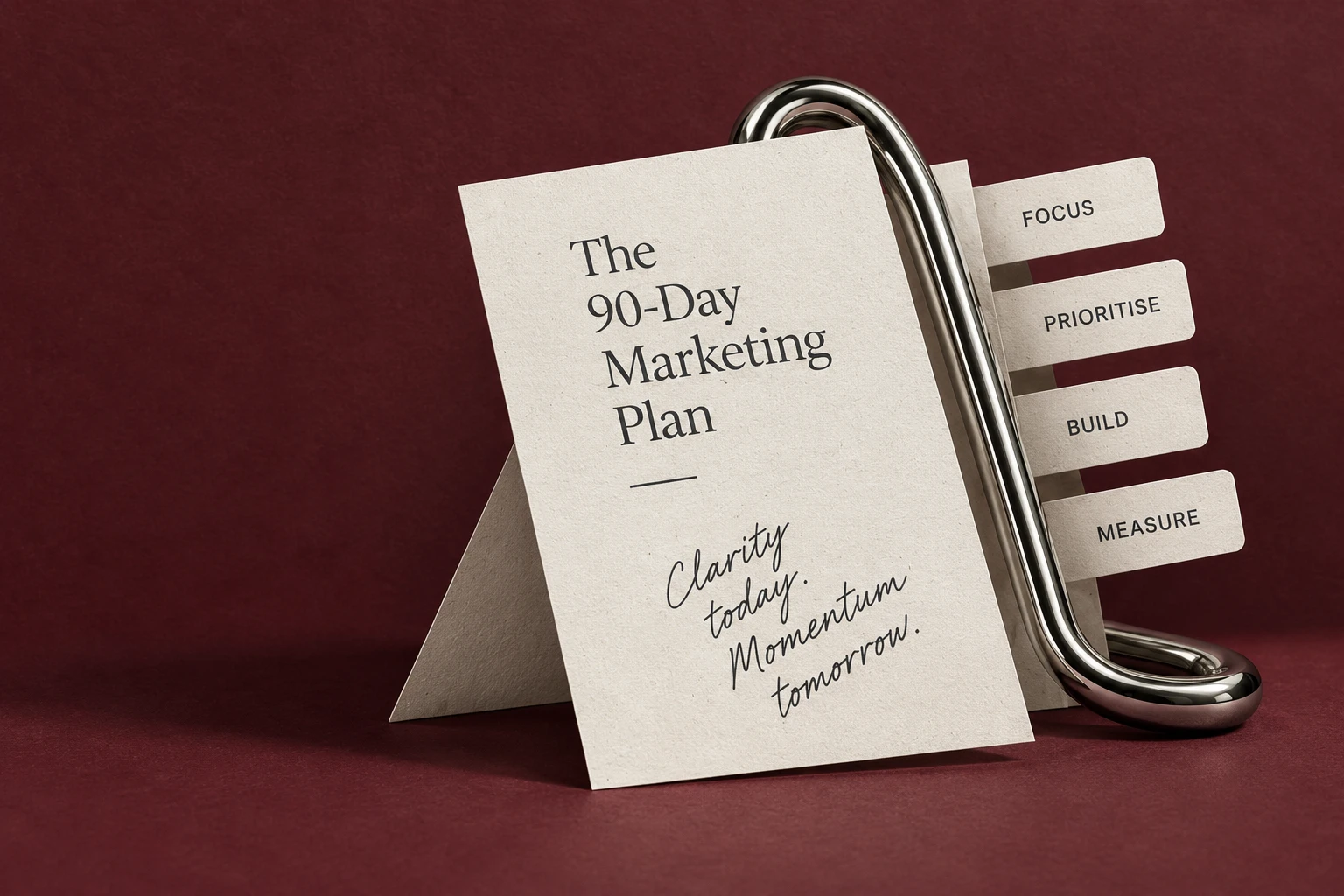

A missing marketing team looks like a hiring problem. Quite often it is a decision problem wearing a job-title costume. Before you add a person, build the small system that tells that person what good work actually means.
Do not start with a job title
When marketing feels stuck, the natural reaction is to write a job ad. The imagined new hire is expected to fix positioning, run campaigns, brief agencies, improve the website, make content, understand analytics and somehow become popular on LinkedIn before lunch.
That is not a role. It is a pile of unresolved choices.
A good first question is not ‘Who should we hire?’ It is ‘What must marketing reliably do for the business?’ The answer might be generating qualified conversations, explaining a complicated product, opening a new market or helping sales close with less friction. Choose the job before you choose the job title.
Weeks 1 and 2: find the truth
The first fortnight is not for a grand campaign. It is for getting close to reality. Talk to customers. Listen to sales calls. Read the last ten proposals. Look at where leads came from, why deals stalled and which pages people visit before they contact you.
I also look at the forgotten corners: old decks, abandoned campaigns, half-finished case studies and useful ideas sitting in someone’s notes. Most companies have more raw material than they think. It is simply scattered across too many heads and folders.
- What problem do customers describe in their own words?
- Which offer is easiest to understand and easiest to buy?
- Where does commercial momentum currently slow down?
- What useful proof already exists?
A plan is useful only when Tuesday morning looks different.
Martin Palmet
Weeks 3 and 4: make the few decisions
Strategy is mostly the relief of deciding what not to do. Pick the audience, the problem, the promise and the commercial outcome for the quarter. Then write them down in language a normal person can repeat.
This is where many plans become decorative. They list every audience, every channel and every possible ambition. A working plan is smaller. It should fit on one page and survive a Monday meeting without needing its author to translate it.
Days 30 to 60: build one repeatable motion
Now choose one useful route to market. It might be founder-led content that creates sales conversations, a focused outbound campaign, partner marketing, a conversion-led website sprint or a customer story programme. The right choice depends on the business, not on what is fashionable this month.
Build the smallest version that can teach you something. Give it an owner, a brief, a deadline and a clear next action for the audience. One motion that runs every week is worth more than six exciting ideas that wait for spare time.
Days 60 to 90: measure, cut and repeat
By now there should be evidence. Not certainty, but evidence. Which messages get a response? Which conversations are qualified? Where do people hesitate? What is taking too long to produce? Review that evidence every week and change the work while it is still alive.
Keep the scorecard short. Revenue takes time, so include leading signals such as replies, booked calls, return visits, proposal quality or sales usage of new material. If a metric never changes a decision, it is probably reporting furniture.
What should exist on day 90
At the end of 90 days, you should have more than activity. You should have a point of view, a working rhythm, a small library of useful assets and a clearer idea of the capability you actually need next.
Perhaps that means hiring. Perhaps it means a specialist partner, a part-time lead or a smaller internal role than you first imagined. The system makes the next decision visible. That is the real value of the first 90 days.
One last thought
Keep what is useful.
Do not wait for the perfect team before marketing starts behaving like a team. Give the work a direction, an owner and a rhythm. The org chart can catch up later.